
◆ In short
The Mass booklet is not compulsory, but it helps guests follow the ceremony and join in the responses. It follows the order of the rite: introductory rites, Liturgy of the Word, the marriage rite (vows and rings) and, if there is a Mass, the Liturgy of the Eucharist, then the concluding rites. The handiest format is a stapled A5, with a page count that is a multiple of 4: usually 12–16 pages without Mass, 16–24 with Mass and hymns. Print one for every two guests plus a few for the celebrant, readers and musicians, and settle the texts with the priest at least three weeks before.
What it is for (and whether you need one)
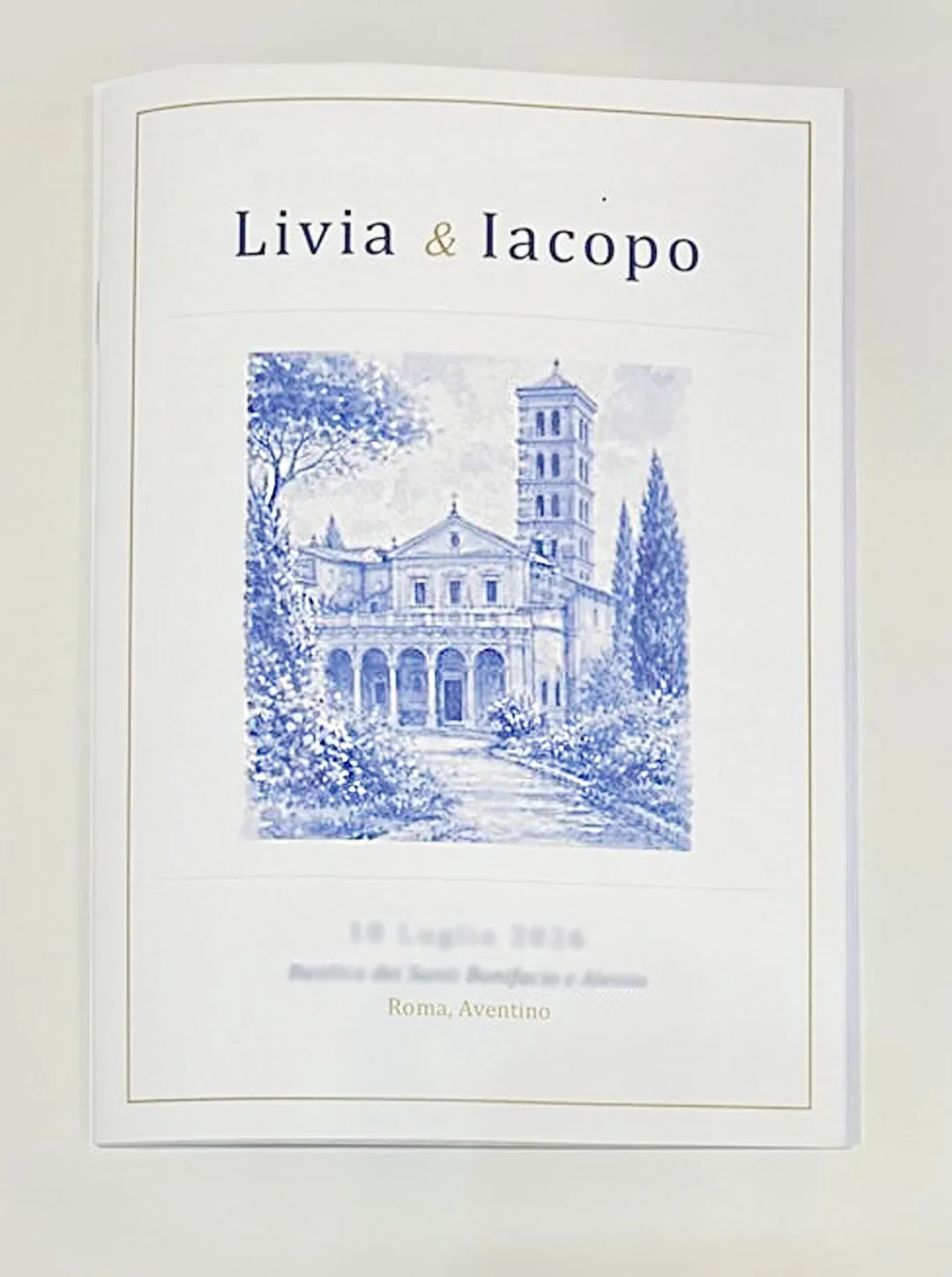
The Mass booklet is the stapled programme guests find on the pews: it sets out the order of the ceremony, the text of the readings, the congregation's responses and the hymn lyrics. Nobody requires it — neither the parish nor the liturgy — and the wedding is perfectly valid without one.
It does three useful things, though:
- it lets guests who rarely attend Mass take part, instead of standing silent during responses and hymns — and in Rome many guests come from abroad and do not follow Italian;
- it names the readers, witnesses and musicians: an elegant way to thank them;
- it is a keepsake: one of the few printed items from the wedding that guests take home.
If the ceremony is small and the guests know the liturgy, a folded sheet with readings and hymns may be enough. From about fifty guests up, a stapled booklet is the easier choice.
What goes inside, in the order of the rite
A Catholic wedding can be celebrated within Mass or without Mass, in the Liturgy of the Word only: that is the first thing to ask the priest, because it changes the booklet's length by almost half. The order of the parts, in the marriage rite used in Italy, is:
- Cover — names of the couple, date, church and city.
- Introductory rites — the entrance hymn, the celebrant's greeting and, where used, the remembrance of Baptism.
- Liturgy of the Word — first reading (usually Old Testament), responsorial psalm with the refrain the congregation repeats, second reading, Gospel acclamation, Gospel, homily. Next to each reading, the name of the reader.
- The marriage rite — the priest's questions to the couple, the consent (vows), the reception of consent, the blessing and giving of rings, the prayer of the faithful (often written by the couple or their friends).
- Liturgy of the Eucharist, only with Mass — preparation of the gifts, Eucharistic prayer, Lord's Prayer, nuptial blessing, sign of peace, communion and its hymns.
- Concluding rites — final blessing, signing of the registers with the witnesses, recessional hymn.
- Thank-you note — two lines from the couple, on the last page or the back cover.
The readings are chosen with the priest from those the rite offers: not something to decide alone and announce once printed. Likewise, where some parts fall — the nuptial blessing, for instance — depends on how the celebrant runs the ceremony. So the booklet is final only after the priest has seen the draft. For international guests, a bilingual booklet (Italian and English on facing pages) roughly doubles the inside pages.
How many pages: why always multiples of 4
A booklet stapled through the spine (saddle stitching) is made of sheets folded in half: each sheet becomes four pages. So the total page count, cover included, is always a multiple of 4: 8, 12, 16, 20, 24. If your text runs to 14 pages, the booklet will have 16 and two will be blank — better that you decide where.
As a rough guide:
- without Mass, with readings, vows, rings, prayer of the faithful and three or four hymns: 12–16 pages;
- with Mass: 16–24 pages;
- with every hymn in full, a bilingual booklet, or short explanations of each rite for non-Catholic guests: 24–32 pages.
Spare blank pages fill nicely with a photo of the couple, the full text of the prayer of the faithful, or a full-page thank-you.
How many copies to print
The rule that works is one booklet for every two guests: couples and families share one, and children do not read it. For a hundred guests, fifty copies are enough.
Add five to ten copies for the people who really need one:
- the celebrant and whoever assists;
- the readers and witnesses;
- the choir or musicians (who often want one each);
- three or four keepsake copies for you and your parents.
A few extra copies beat a reprint: a second run of ten costs proportionally far more and happens when the days are already short.
Format, paper and cost
The handiest format is A5 (14.8 × 21 cm): you hold it in one hand, it fits in a bag and reads without glasses even from the back pews, as long as body text does not go below 11 point. A4 only makes sense when you need very large type.
Paper:
- 80 gsm inside — light, turns easily, perfect for a text booklet;
- 150 gsm inside — more substantial, recommended if there are photos;
- 200 gsm card cover — gives the booklet the feel of a small book and holds up through the ceremony (and as a fan in a hot church in summer).
Black and white inside costs far less than colour and works well for readings and hymns.
Two price examples from our online price list, a 16-page stapled A5 booklet, 80 copies:
- cover and inside on 80 gsm, black and white: € 64;
- the same with a 200 gsm card cover: € 224.
For the exact price with your pages and copies, upload the PDF at shop.guug.it/opuscoli: online we print A5 and A4 booklets from 8 to 48 pages, 1 to 500 copies. Other formats, coloured papers or a matching suite with invitations and place cards are quoted separately via the wedding printing page.
Timing and file: the countdown
Printing is the last and quickest step: online, booklets are ready 24 working hours after payment, for pickup at our shop in Rome or shipped. The real time is needed before that:
- 6–8 weeks before — choose readings and hymns with the priest and the musicians.
- 4 weeks before — first complete draft, with the readers' names.
- 3 weeks before — the draft goes to the priest: he confirms order and texts.
- 1–2 weeks before — final corrections and print order. That leaves room if anything changes.
Preparing the PDF: single pages in reading order — cover, inside, back — at final size (A5). We do the imposition for folding. The page count must be a multiple of 4: add blank pages where you want them. Leave at least 1.5 cm inner margin, towards the fold, because words close to the staples are hard to read.
Mistakes that show on the day
Readings copied from any old Bible
In church the reader reads from the lectionary, which in Italy uses the CEI 2008 translation. If the booklet has another version, guests read different words from the ones they hear. Use the CEI 2008 text (or the official English lectionary for a translation) and have the priest check it.
Type that is too small
Churches are dim and the guests include grandparents. Below 11 point the booklet becomes unreadable for exactly the people who need it most.
Wrong or changed reader names
The cousin who was due to read cannot come, a witness's surname is spelled two ways: names change more than anything else. Confirm them all before the print order, not before the draft.
A page count that is not a multiple of 4
An 18-page PDF becomes a 20-page booklet with two blanks at the end, maybe after the thank-you. Decide where they go: a photo or the full prayer of the faithful fills them nicely.
Frequently asked questions
What goes in a Catholic wedding Mass booklet?
The ceremony in the order of the rite: cover with names, date and church; introductory rites; Liturgy of the Word with readings and psalm; the marriage rite with vows, rings and prayer of the faithful; the Liturgy of the Eucharist if there is a Mass; concluding rites with the signing; the hymns and a short thank-you.
Is a wedding Mass booklet compulsory?
No, neither the parish nor the liturgy requires it. It helps guests follow the ceremony, respond and sing, and it is a keepsake. For a small ceremony a folded sheet with readings and hymns may be enough.
How many pages does a wedding booklet have?
Always a multiple of 4, because it is made of folded sheets: usually 12–16 pages for a wedding without Mass, 16–24 with Mass, 24–32 with every hymn in full or a bilingual text.
How many booklets for 100 guests?
About fifty — one for every two guests, since couples and families share. Add five to ten for the celebrant, readers, witnesses, musicians and family keepsakes.
How much does it cost to print a wedding booklet?
It depends on pages, copies, paper and colour. From our price list, 80 A5 booklets of 16 pages in black and white on 80 gsm cost € 64; with a 200 gsm card cover € 224. The exact price shows online at shop.guug.it/opuscoli when you upload the PDF.
When should the booklet be printed?
One or two weeks before the wedding, after the priest has approved the draft (send it about three weeks before). Online printing takes 24 working hours: the time is needed for choosing and correcting the texts.
◆ Keep reading
◆ Ready to print?