◆ In short
There's no rule requiring it, but the tradition of academic gowns assigns each faculty a colour: burgundy for Medicine, black for Engineering, blue or red for Law, yellow or green for Economics, green for Sciences, purple for Political Science, orange for Psychology, ivory or blue for Humanities. In Rome many students instead pick the university's own colour: Sapienza burgundy, LUISS midnight blue, Tor Vergata green. The choice is free: when in doubt, dark blue or burgundy with gold lettering always works.
In short: which colour for your thesis?
When students walk into the print shop to produce their thesis, the first question is almost never about paper or binding: it's about the cover colour. The colour tradition is real and has precise roots, but it now overlaps with each university's visual identity. When the two diverge, a practical rule holds: Engineering and Architecture keep black and Medicine keeps burgundy at any university, while for other faculties many universities — Sapienza above all — let their own institutional colour prevail; when in doubt, the faculty colour is always a safe choice.
Traditional colours by faculty, at a glance:
| Faculty | Traditional colour |
|---|---|
| Humanities and Philosophy | Ivory or dark blue (#f0e6d0) |
| Economics | Yellow or green (#d4a72c) |
| Law | Blue or red (#0d2a4a) |
| Engineering | Black (#1a1a1a) |
| Medicine and Surgery | Burgundy or dark red (#722f37) |
| Architecture | Grey or black (#525252) |
| Mathematics, Physics and Natural Sciences | Green (#1a4d3a) |
| Political Science | Purple (#5a2d6e) |
| Psychology | Orange (#c2410c) |
In Rome many students instead choose their university's colour: Sapienza burgundy, LUISS midnight blue, Tor Vergata green. No rule is binding. Need it printed? Thesis printing in Rome in 2 hours.

The origin: academic gowns
The colours of Italian university faculties were not conceived as a spec for the thesis cover. They come from the academic gowns worn by professors during official ceremonies (the opening of the academic year, formal graduation sessions, academic processions). In Italy the gowns are black and trimmed with the colours proper to each faculty: blue for Humanities, green for Sciences, red for Medicine, and so on.
The tradition goes back to the 12th century, when Europe's first universities were founded (Bologna, Padua, Paris, Oxford). Each faculty developed its own colour iconography, inherited in part from the ecclesiastical and political symbolism of the time: the red of the Roman togas of high office, the blue of rationality, the green of growth, the white of philosophical purity.
When, centuries later, students began printing their theses with a hardcover, it felt natural to reuse those colours: the thesis is the graduate's official document, and it deserves the same colour code as the committee's gowns. That is where the custom came from — unwritten, not mandatory, but widespread — of matching the cover to the faculty.
What are the nine traditional colours by faculty?
This is the most common map across Italian universities. There are some variations (covered below, university by university), but the historical core is stable.
Humanities and Philosophy — Ivory or dark blue (#f0e6d0). The humanities are historically associated with ivory white (purity, inspiration, classical tradition). At many universities the cover is instead a dark or midnight blue, chosen for the restraint that evokes philosophical study.
Economics — Yellow or green (#d4a72c). Yellow is the traditional colour of the Economics gown (a nod to gold, wealth, resource management). Some universities and students prefer green, a symbol of growth and prosperity. In Turin and Genoa yellow is often replaced by grey. → The detail for Economics, university by university, with the foil combinations that work on yellow.
Law — Blue or red (#0d2a4a). At many Italian universities the Law gown is trimmed in blue, a colour tied to rationality and the authority of the law. Red remains a common choice for the cover: it recalls the tradition of the Roman togas of high public office.
Engineering — Black (#1a1a1a). Black is the almost universal colour for Engineering theses. Restraint, precision, authority: three attributes consistent with the technical nature of the course. Often paired with gold or silver lettering to add value to the volume.
Medicine and Surgery — Burgundy or dark red (#722f37). Burgundy and dark red are the traditional colours for Medicine, Dentistry, Pharmacy and Veterinary Medicine. They represent vitality, health and the importance of caring for life. It is among the most requested colours of all for those printing theses in Rome.
Architecture — Grey or black (#525252). Dark grey or black prevail: neutral colours that let the volume's graphic and design content stand out. At Sapienza, historically, Architecture also uses black, sometimes with small gold symbols on the spine.
Mathematics, Physics and Natural Sciences — Green (#1a4d3a). Green is the gown colour for the MPN sciences: mathematics, physics, chemistry, biology, natural sciences. It represents research, exploration and the bond with nature. Environmental sciences and biotechnology follow this tradition too.
Political Science — Purple (#5a2d6e). Purple identifies the Political Science gowns: the colour of wisdom, dignity and authority in academic tradition. Some students, however, choose blue, overlapping with Law by disciplinary affinity.
Psychology — Orange (#c2410c). Orange is the colour of the Psychology gown (alongside related humanistic disciplines). Liveliness, warmth, a balance between reason and emotion. A bold choice, less common than burgundy or blue but visually striking.
Other faculties and minor programmes
- Pharmacy — Garnet red. Close to Medicine, but darker and more orange-toned.
- Veterinary Medicine — Crimson red. Akin to human Medicine, with warmer hues.
- Foreign Languages and Literatures — Amaranth or white. Often amaranth at Sapienza, white at Macerata, pure amaranth at Bologna.
- Sociology — Wine red. Warm dark-red tones, close to burgundy but more purple.
- Communication Sciences — Wine red or orange. Often follows the Sociology or Humanities tradition.
- Sport Sciences — White with a red detail. A recent tradition, often left to the student's choice.
- Cultural Heritage — White or blue. Varies by university: at Verona often white, with the Cultures and Civilisations department.
- Statistics — Bluette. A variant of the Sciences blue, lighter and brighter.
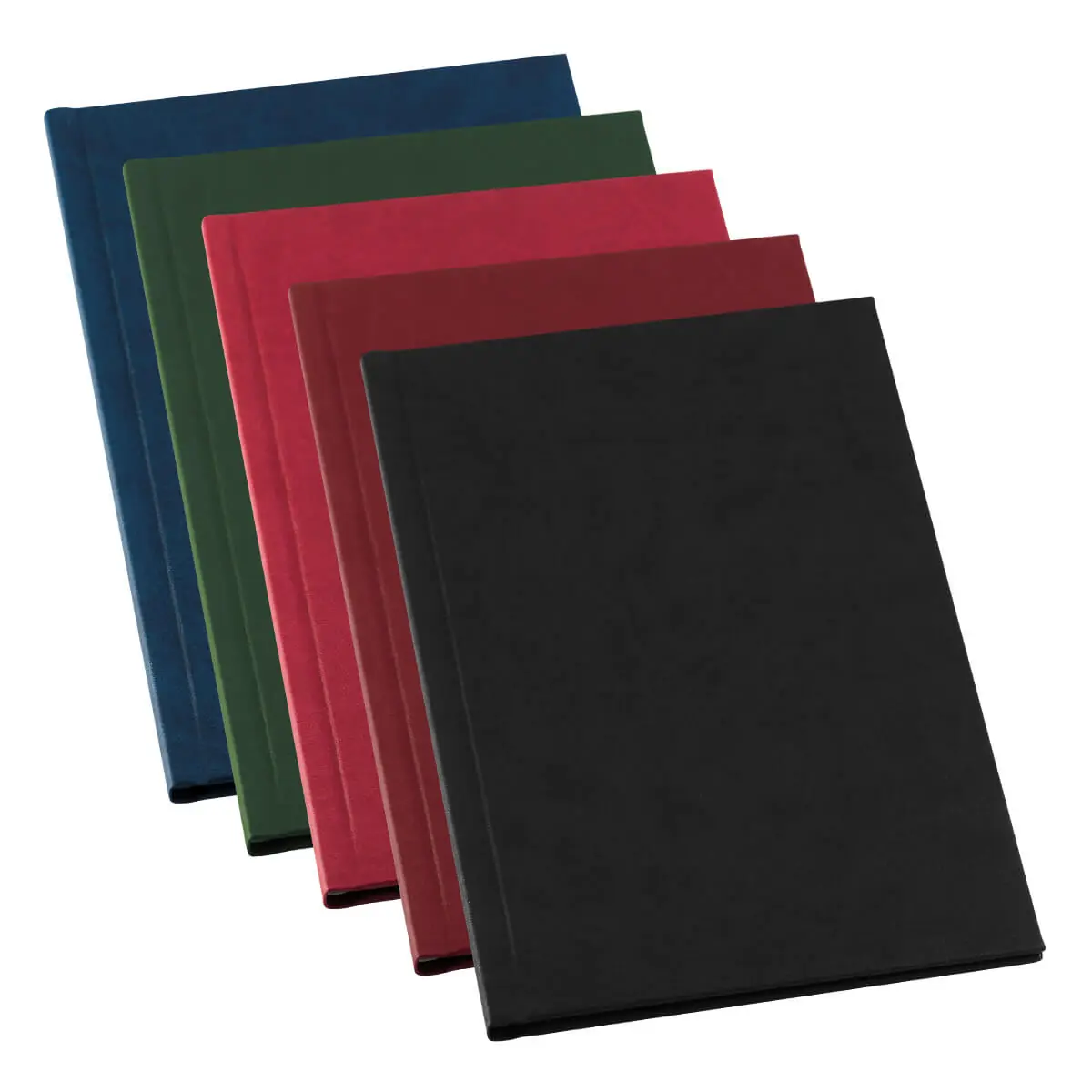
This page is the map. For the four faculties we are asked about most we have a dedicated guide that goes university by university and explains how that colour actually turns out on the material: Engineering · Law · Economics · Medicine.
Which thesis colour do Rome's universities use?
Over the past twenty years the faculty tradition has given way to another logic: the university's colour. Sapienza, LUISS, Tor Vergata and Rome's other major universities have built a strong visual identity, and many students choose to echo it on the cover — rather than the traditional colour of their degree course. Here's what we actually see at the counter. These are trends, not rules.
Sapienza University of Rome — Burgundy / dark red (#802433). Sapienza's institutional colours are red, gold, black and white (source: the official visual identity manual). For theses this almost always translates into a deep burgundy or dark red with gold lettering: the thesis echoes the university's identity before the faculty colour. Historical exception: Engineering and Architecture, which keep black.
LUISS Guido Carli — Institutional midnight blue (#013a71). LUISS has no written rule, but at the counter the choice is almost always the same: institutional midnight blue. It's the university's colour, applied across all courses (Economics, Law, Political Science, Business and Management). The most requested cover is midnight-blue leatherette with high-definition gold or silver lettering.
University of Rome Tor Vergata — Green (#1a4d3a). Tor Vergata has an official visual identity system (DR 1449/2023) and its institutional colours lean towards green. Theses follow suit: dark green for most courses, with a few exceptions for Medicine (burgundy) and Engineering (black), which keep the faculty tradition.
Roma Tre University — Blue (#1e4574). At Roma Tre blue prevails in various shades, with the student free to choose by course. The Architecture faculty keeps black. Humanities and Education Sciences often opt for blue or a light ivory.
LUMSA — Dark green (with gold details) (#1a4d3a). At LUMSA (Libera Università Maria Ss. Assunta) the distinctive choice is dark green, often paired with gold details. The university's Catholic character steers towards a sober, distinctive colour, different from the blues or burgundies more common at other Rome universities.
Academy of Fine Arts of Rome — Expressive freedom (#7a4490). At the Academy the rule is... that there is no rule. Students choose the colour to suit their thesis project: purple, dusty rose, cyclamen, sage green, alongside the colour traditions of other faculties. It's the one context where the cover truly becomes an extension of the work.
Other universities and academies in Rome
For these institutions the colour tradition is less codified and the choice stays tied to the degree course or personal preference. The most reliable reference remains each university's thesis regulations or your supervisor.
- NABA (New Academy of Fine Arts)
- IED (European Institute of Design)
- RUFA (Rome University of Fine Arts)
- Quasar Institute
- Pegaso Online University
- Unimarconi Online University
- Unicusano Online University
- Foro Italico (IUSM Sport Sciences)
- Koefia Academy
How to choose: the practical rule
Stripped to the essentials, the choice comes down to three steps.
- Ask your supervisor or the registrar. Some courses have specific guidance, written or spoken. It's rare, but it happens: better to find out before printing.
- Consider the university before the faculty. If you graduate from LUISS in Law, LUISS midnight blue is a more recognisable choice than Law blue. Same logic for Sapienza (burgundy) and Tor Vergata (green).
- See the colours in person. The shades on online swatches rarely match those on leatherette. In the shop you can compare burgundy, midnight blue, black and green and decide with the cover in hand. It's the difference between an ordinary thesis and one you'll remember.
At GUUG, in Rome's Prati district, we've been printing theses for over twenty years: the hardcover is ready in 2 hours, thermal binding in 5 minutes. You can configure your thesis online with a colour preview, or drop by to see them in person.
The colours students actually choose: 3,700 bound copies
The faculty tables tell the tradition. But what do graduates actually choose? We counted the covers that came out of our workshop in Rome's Prati district: 3,700 thesis copies recorded from 2020 to 30 September 2026.
The most chosen thesis cover colour is blue (33.9%), followed by burgundy (19.7%), green (17.3%) and red (10.7%). For the title lettering, 61.7% choose gold foil, 26% silver.
| Colour | Share | Hex |
|---|---|---|
| Blue | 33.9% | #0d2a4a |
| Burgundy | 19.7% | #722f37 |
| Green | 17.3% | #1a4d3a |
| Red | 10.7% | #a52830 |
| Pearl white | 8.7% | #cfc8bd |
| Black | 3.4% | #1a1a1a |
| Beige | 2.7% | #b8a585 |
| Others (lilac, pink, powder blue) | 3.1% | #9b7fae |
Title lettering: gold 61.7%, silver 26%, other foils 12.3%. Source: paid GUUG thesis orders recorded in our system from November 2020 to 30 September 2026 (3,700 copies from 2,024 orders); percentages of copies, 0.5% with no colour specified. Data citable with a link to this page. Full method and more figures (copies, cost, pages, seasons) in the Thesis Observatory 2026.
Frequently asked questions
At Sapienza, which thesis colour is usually chosen?
At Sapienza most students choose burgundy or dark red with gold lettering, in line with the university's institutional colours (red, gold, black, white). The most common exceptions are Engineering and Architecture, which keep black, and Medicine, which stays on dark red by faculty tradition. You can see the colours in person at our shop in Rome (Prati), or in the preview of our thesis configurator.
At LUISS, which colour is used?
At LUISS the thesis cover is almost always institutional midnight blue, the same blue as the university's brand. It applies to all courses: Economics, Law, Political Science, Business and Management. The lettering is in high-definition gold or silver, on smooth or hammered leatherette.
At Tor Vergata, Roma Tre and LUMSA, which colours do they use?
Tor Vergata leans towards dark green for most courses, with exceptions for Medicine (burgundy) and Engineering (black). Roma Tre uses various shades of blue with great freedom of choice. LUMSA favours dark green, its university colour, always with gold details.
Do I have to follow my faculty's traditional colour?
No. No official regulation prescribes a colour for the thesis cover: the faculties' colour tradition is a legacy of academic gowns, not an administrative rule. Our advice is to ask your supervisor or the registrar whether there is specific guidance; if not, the choice is free. More and more students decide based on the thesis topic, the university, or the outfit they'll wear on graduation day. If you'd rather decide with the colours in hand, at our shop in Rome (Prati) you can flip through the actual cover samples.
Can I see the colours in person before choosing?
Yes, and it's the best thing to do. In our Rome Prati shop we keep the full sample set of hardcovers with every colour and finish (smooth leatherette, hammered, eco-leather, leather effect). If you prefer, you can also order your hardcover thesis online at shop.guug.it/tesi: the configurator shows a colour preview before checkout.
Does the thesis colour differ between bachelor's and master's?
No: the cover colour depends on the faculty and the university, not the level of the degree. A bachelor's and a master's thesis in the same faculty use the same traditional shade (e.g. burgundy for Medicine, midnight blue at LUISS). The practical difference is thickness: a master's thesis is usually thicker, so the hardcover looks even better.
What colour is the graduation ribbon?
The graduation ribbon or rosette follows the same traditional faculty colours inherited from academic gowns: red for Medicine, blue for Law, yellow for Economics, black for Engineering, blue-green for Humanities, and so on. It's an unregulated celebratory accessory: many people match it to the thesis cover colour for consistency on graduation day.
Which cover colour for a special-needs teaching (TFA) or specialisation thesis?
For the TFA special-needs teaching qualification, master's programmes and specialisation schools there is no dedicated colour: you follow the custom of the relevant faculty (often Education Sciences, which leans towards blue or green) or the university's institutional colours. Without guidance from the registrar the choice is free: when in doubt, dark blue or burgundy with gold lettering remain the most restrained and always-appropriate options.
◆ Keep reading
◆ Ready to print?