◆ In short
Invitations go out 2-3 months before the wedding (4-6 months if guests are travelling from abroad or you marry in high season), so they should be ordered 3-4 months ahead: between draft, corrections and a physical proof a few weeks pass, and there is never just one round of corrections. The rule that saves the budget: count households, not people — one envelope per couple, one per family — then add 10-15% for mistakes, second thoughts and copies to keep. On fine papers the matching envelope is included, and before printing you always see a digital draft and a physical proof.
The real calendar, counting back from the day
Almost all the panic around invitations comes from the same mistake: people think about the sending date and not the ordering date. More time passes between the two than you would expect.
Here is the countdown that works:
- 12-6 months out — the save the date. Only needed if you marry in high season, in a holiday destination, or have guests who must book flights. It does not replace the invitation: it precedes it.
- 4-3 months out — the order. Time to bring us your wording and ideas. The round of drafts starts here.
- 3-2 months out — sending. Two months is the comfortable minimum, three if many guests travel. Below six weeks you put people in difficulty.
- 1 month out — the RSVP deadline. It goes on the invitation, and it is what lets you give final numbers to the venue. Without a written date, half the replies arrive the week before.
Why order three months ahead and not one: between the first draft and approval there are typically two or three rounds of corrections — a misspelled name, a time that changes, a grandmother to be added among those inviting. Then there is the physical proof: paper in your hands changes how you judge colour and text size, and choices do get revised. Only after that does the run get printed.
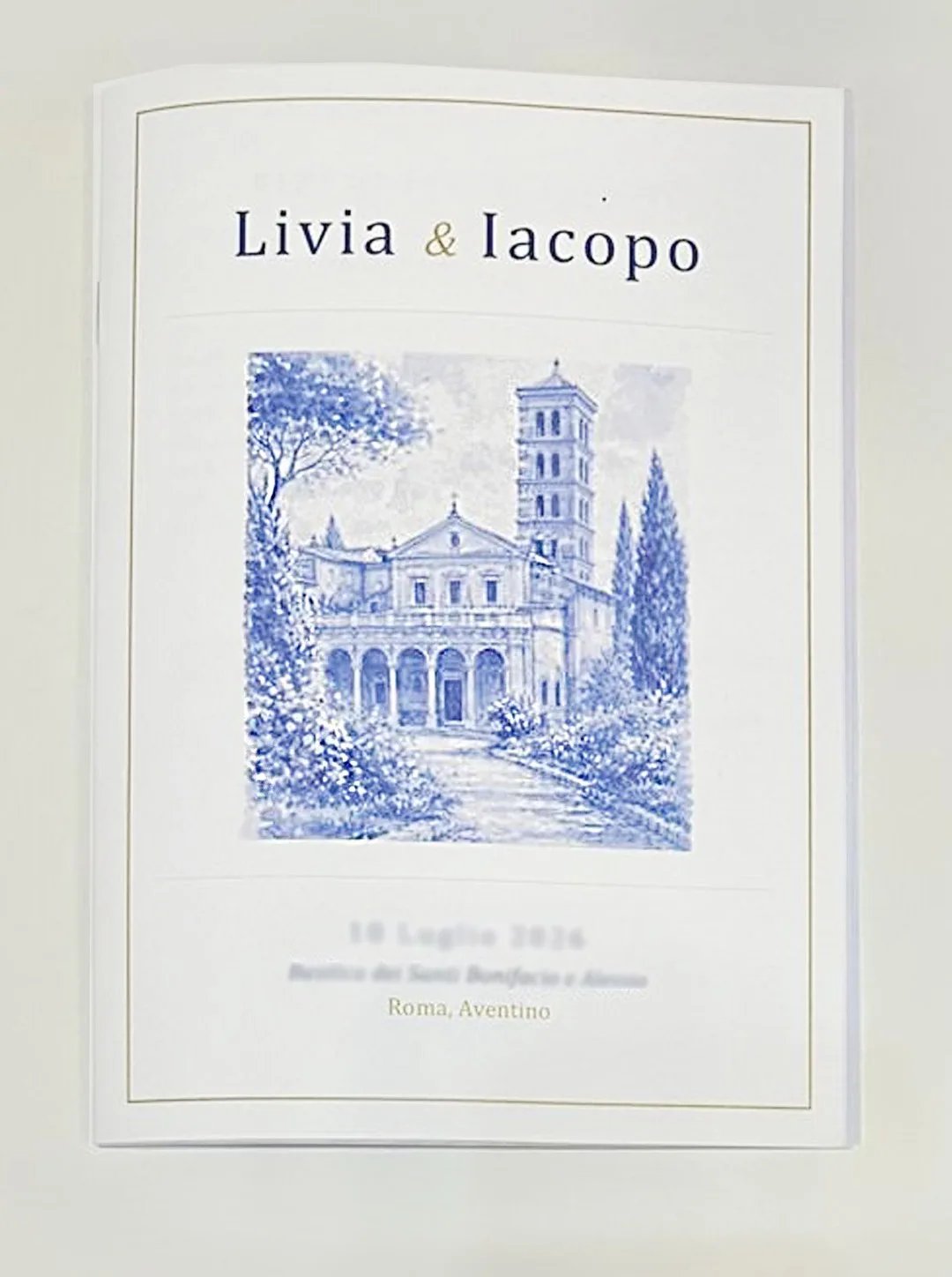
The eight elements that cannot be missing
An invitation can be three lines or half a page, but these eight pieces of information have to be there. The first five are the ones whose absence generates phone calls.
- Who is inviting. In the traditional formula the parents invite; in the modern one the couple does. Neither is correct in itself: the right one is the one that sounds like you. With large or blended families, two clear lines beat an elegant but ambiguous formula.
- The couple's names, in full and spelled the way they spell them.
- The full date, with the day of the week: Saturday 12 September 2026. The weekday prevents half the misunderstandings.
- The ceremony time. One time only, the start.
- The ceremony venue, with name and full address — not just "St John's Church", which in Rome is ambiguous.
- The reception venue, with address. If it is far from the ceremony, it is worth adding the travel time.
- RSVP with a date and a contact. "Please confirm by 10 August to Giulia 333…". The date is the part everyone forgets and the part that works.
- Practical notes, if needed: dress code, parking, shuttles, whether children are welcome. If there are many notes, a separate information card beats a crowded invitation.
On language: if you have foreign guests, the elegant route is not a crowded bilingual invitation but the same invitation printed in two versions. The text breathes and everyone gets theirs.
How many to order: count households
This is the costliest mistake, and it takes a second to make: counting guests instead of envelopes.
A hundred guests are not a hundred invitations. A couple receives one envelope. A family with two grown children receives one, or two if the children live independently. For a hundred guests, actual invitations usually number between fifty and sixty.
Once you have that figure, add 10-15%. That is not vague caution, it is three concrete things:
- Mistakes writing the envelopes. It always happens, and a badly written envelope cannot be salvaged.
- Last-minute guests: the colleague who was not on the list, the rediscovered relative.
- Keepsake copies: yours, your parents', one for the album. That is three or four, and nobody counts them.
⚠️ Reprinting later costs disproportionately. Digital printing has no plates, but a second run of ten still pays for set-up: ten invitations ordered separately cost far more than ten added to the original run. Better ten extra now than ten in a hurry later.
A practical tip on envelopes: if you are addressing them by hand, ask for a few spare blanks. Handwriting tires, and by the thirtieth envelope your hand is not the one from the first.
The suite: what you actually need and what you do not
The minimum that works
Invitation + envelopeThe invitation with its matching envelope included. If there is little practical information, it fits on the back or at the foot.
The right choice for an intimate wedding, or when the paper budget is better spent on the quality of one piece than the quantity of pieces.
The information card
The most useful pieceA small card in the same envelope: addresses with directions, shuttle times, parking, dress code, gift list, RSVP.
Why it matters: it frees the invitation from logistics and lets it do its job. If you are unsure what to add to the minimum, add this.
The full suite
€ 600-900 with artwork readyInvitations, order of service, place cards, menus, seating chart and thank-you cards, all coordinated.
- If the artwork is yours: from € 600-900
- With design by our in-house studio: design starts at € 400 on top, depending on complexity
It makes sense when you want the whole day to speak one visual language — and it is the case where deciding everything at the start beats deciding piece by piece.
After the wedding
Favour cards from € 39 · 50 pcsFavour cards are ordered online: 50 pieces € 39, 100 € 59, 200 € 99, with a ribbon hole at € 5.
They are the last thing anyone thinks about and the first to be needed, usually in a rush. Ordering them with everything else costs less than remembering them three days before.
Papers and finishes, without overdoing it
Wedding invitations are one of the few printed things people hold and then keep: the paper is felt, and remembered.
The families to choose from:
- Ivory wove — the classic: slightly textured surface, warm tone, formal look. It suits black printing and foils.
- Fedrigoni coloured stocks — when the wedding has a palette and you want it in the envelope already.
- Recycled — visible texture, natural tone. Lovely for outdoor weddings and for anyone wanting a choice consistent with the rest.
- Coated card — if the invitation carries a photograph or a colour illustration, because it renders colour fully.
Two finishes genuinely change the object: gold or silver foil, which catches the light immediately, and embossing, which you do not see until you touch it. They cost, and they do not belong everywhere: one well-chosen touch — the names, or an initial — beats three effects together.
A warning we repeat often: paper and colour must be seen in person. Ivory on a screen and ivory in your hand are two different things, and foils simply do not exist on a monitor. That is why, before the run, there is always a digital draft and a physical proof: the proof exists precisely to prevent the sentence "I thought it was lighter".
Frequently asked questions
When should wedding invitations be sent?
Two to three months before the wedding; four to six if guests travel from abroad, if you marry in high season or in a holiday destination. Below six weeks you put people in difficulty. So they should be ordered 3-4 months ahead, because draft, corrections and a physical proof take a few weeks.
What do you write on a wedding invitation?
Eight things: who is inviting (parents in the traditional formula, the couple in the modern one), full names, the complete date with the day of the week, the ceremony time, the ceremony venue with address, the reception venue, an RSVP with a date and a contact, and any practical notes. If the notes are many, use a separate information card.
How many invitations do I need for 100 guests?
Usually between 50 and 60, because you count households, not people: one envelope per couple, one per family. Add 10-15% on top for envelope mistakes, last-minute guests and keepsake copies. Reprinting ten later costs far more than adding them to the first run.
How much does a full wedding suite cost?
With artwork ready, from around € 600-900 for invitations, order of service, place cards, menus, seating chart and thank-you cards. If our studio designs it, design starts at € 400 on top depending on complexity. Favour cards can also be ordered online: 50 pieces € 39.
Can I see a proof before the whole run is printed?
Yes, and we always do: first a digital draft to check wording and layout, then a physical proof on the chosen paper. The proof is not a formality: ivory on screen and ivory in hand are two different things, and foils are simply invisible on a monitor.
◆ Keep reading
◆ Ready to print?