
◆ In short
An Italian graduation favour tag carries the graduate's first and last name and the graduation date: that is all anyone actually reads on a card a few centimetres wide. A title is optional — «Dott.» / «Dott.ssa» applies to the bachelor's degree too, «dottore magistrale» to the master's. The usual size is small (ours is 5 × 2.5 cm folded, opening like a book), you order one tag per favour bag plus 10%, and you order two to three weeks before the party. Online from € 12 for 50.
What goes on a graduation favour tag
The tag is the signature of the favour: it tells whoever receives it whose party it was and when. Everything else is optional. In order of importance:
- The graduate's first and last name, written out in full, the way they write it themselves.
- The graduation date — the day of the proclamation, not the party if that falls on another day. Written out («15 luglio 2026») or in figures («15.07.2026»).
- The title, if you want it: «Dott.» or «Dott.ssa» in front of the name. In Italy it is correct for the bachelor's degree too (see below).
- The degree course, if there is room: «Laurea in Economia», «Laurea magistrale in Architettura». On a small card it is usually the first thing to go.
- A short line of text, only if the format is big enough not to squeeze the name.
The rule that always applies: on a five-centimetre tag, two or three lines read comfortably. Every extra line makes the others smaller, and the name — the only thing that matters — ends up the smallest. When in doubt, cut.
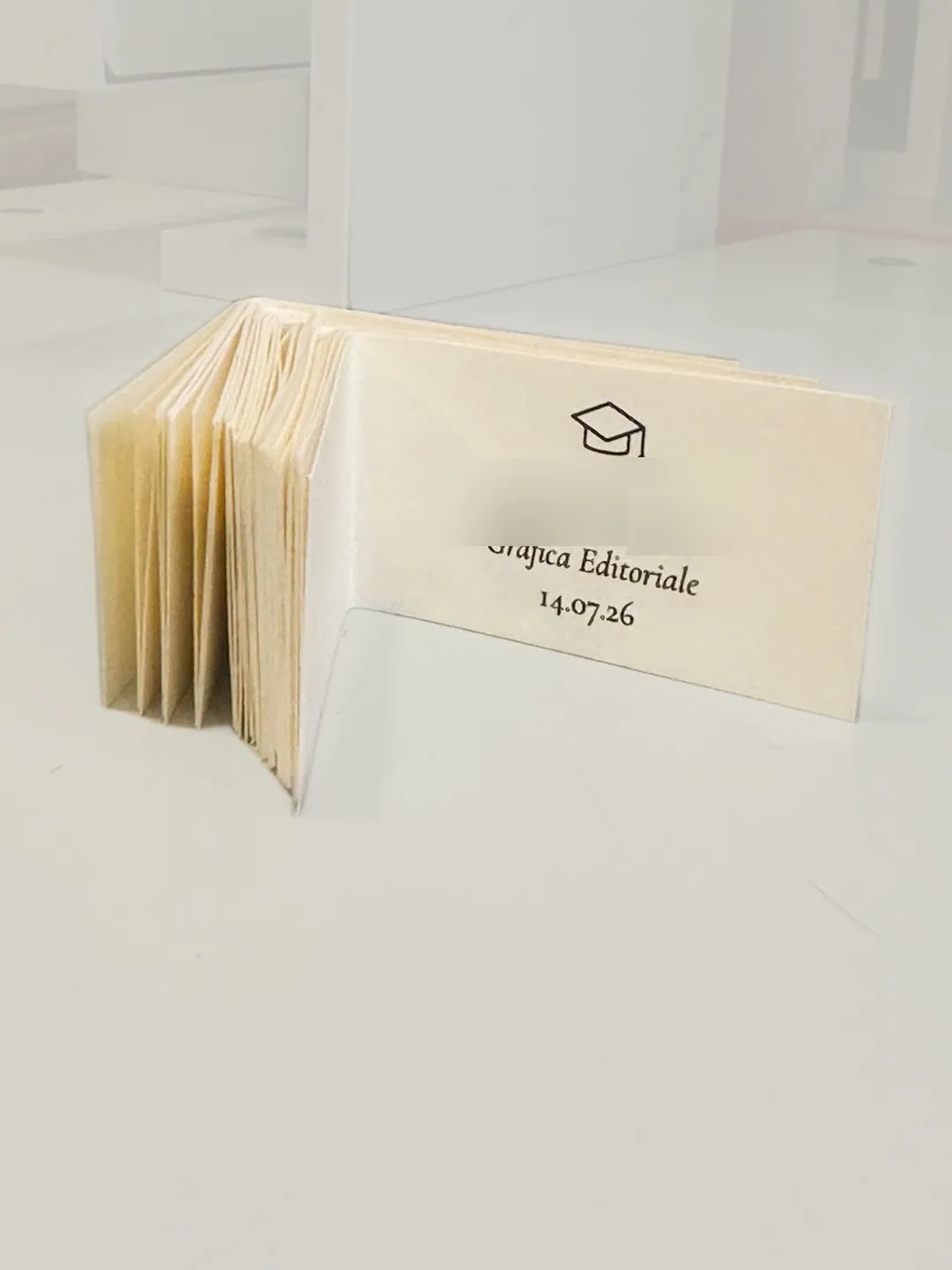
Ready-made examples, from plain to personal
The classic
Two lines · always worksGiulia Rossi
15 luglio 2026
The most common formula, for a reason: it reads from a metre away and never dates.
With the title
To underline the milestoneDott.ssa Giulia Rossi
15 luglio 2026
Or, for a master's, «Dott. Marco Bianchi» with «Laurea magistrale in Ingegneria civile» underneath if the format allows.
With the degree course
Three lines · needs a larger formatGiulia Rossi
Laurea in Scienze della Comunicazione
15.07.2026
Useful when several people graduate at the same party, or when the course says a lot about who is celebrating.
With a short line
Under 35 charactersLines that fit on a tag (in Italian, as guests will read them): «Grazie di esserci stati» (thank you for being here), «Missione compiuta» (mission accomplished), «Il primo di tanti traguardi» (the first of many milestones). And the Latin ones everyone likes: «Ad maiora» (on to greater things) and «Per aspera ad astra» (through hardship to the stars).
«Dott.» for a bachelor's degree too? Yes
It is the most common question, and the answer is in Italian law: ministerial decree 270 of 2004 (art. 13) states that whoever earns a laurea (the three-year bachelor's) holds the title of dottore, a laurea magistrale (master's) gives the title dottore magistrale, and a PhD gives dottore di ricerca.
So «Dott.» and «Dott.ssa» on a bachelor's tag are correct, not an exaggeration — this is different from English-speaking countries, where «Dr» is reserved for doctorates. For a master's, plain «Dott.» is fine: «dottore magistrale» in full is correct but takes a whole line on a small card.
The title is still optional: many people prefer just name and date, the plainest formula and the most legible.
Size, paper and image
Favour tags are small by nature: they hang from a bag of sugared almonds or sit on a little box without covering it. The common formats range from business-card size downwards.
Ours measures 5 × 2.5 cm folded and opens like a book (10 × 2.5 cm open): an image on the front, first name, last name and date inside. We print on hammered Modigliani paper, 120 gsm, in white or ivory: the slightly embossed surface makes the card look finished even a few centimetres from your eyes.
White or ivory? White is crisper and makes the image colours pop; ivory is warmer and goes well with a red ribbon. There is no wrong choice: what matters is how it matches the rest of the favour.
The front image can be one of three academic icons — mortarboard, laurel wreath, thesis — or your own upload (PNG, JPG or SVG). If you upload a logo or drawing, keep it simple and sharp: at two and a half centimetres high fine details vanish and small lettering inside the image becomes unreadable.
The ribbon hole and ribbon colour
The tag is either tied to the bag with ribbon or glued onto the box. If you tie it, you need a hole: we punch it, top right or bottom right, for € 5 per order (not per piece). With the hole already there, packing a hundred favour bags takes an evening instead of a weekend with a hole punch.
For the ribbon colour, the laurel-wreath tradition applies: red works for everyone, or you use the faculty colour — bordeaux for Medicine, black for Engineering, navy or red for Law, yellow or green for Economics. The full map is in the thesis colours guide; the other traditions of the day — sugared almonds, laurel, flowers — are in the Italian graduation party guide.
How many tags to order (and what they cost)
The right count starts from the favours, not the guests: one tag per bag or box. If you make one bag per family, count families; one per guest, count guests.
Add 10% to that number: a few tags get damaged while you tie the ribbon, a few guests turn up at the last minute, and you will want to keep a couple (parents always ask).
Ours come in packs, VAT included:
- 50 pieces — € 12
- 100 pieces — € 20
- 200 pieces — € 38 (about € 0.19 per tag)
- ribbon hole: +€ 5 on the whole order
If your count falls between two packs — say 60 — take the larger one: the price gap is small, and running out of tags halfway through packing is the real problem.
When to order: two to three weeks before the party. Not for the printing but for you: after the order we prepare a proof and email it to you, and then everything has to be packed.
Print them at home or have them printed?
DIY with a home printer
- ✓Low out-of-pocket cost if you already own a printer and card
- ✓You can change the text up to the last minute
- –Hand-cutting a hundred identical 5 cm rectangles takes hours, and a crooked edge shows
- –Home printers often will not feed heavy card
- –Small lettering comes out blurred on textured paper
Best for
A handful (20–30) for a family party.
Printed by a print shop
- ✓Precise cutting, all identical
- ✓Real hammered paper, with a preview before you pay
- ✓Ribbon hole already punched
- –The text has to be final before you order
Best for
From 50 pieces up, or whenever you want a uniform result without losing a weekend.
How to order ours, in three steps
The tags are configured online at shop.guug.it/inviti, at any hour, with a preview of the front and inside that updates as you type (the editor is in Italian, but it is three fields and a button):
- Compose — pick the icon (mortarboard, laurel wreath, thesis) or upload your own image, type first name, last name and date, choose white or ivory paper and, if needed, the ribbon hole.
- Quantity — 50, 100 or 200 pieces; the total already includes the hole.
- Payment — by card, with an email confirmation.
Before confirming, check the name letter by letter: it is the most common mistake and the only one that cannot be fixed after printing. If you also need invitations to the reception or larger thank-you cards with a message, see the invitations page.
Frequently asked questions
What do you write on Italian graduation favour tags?
The graduate's first and last name and the graduation date: the two things anyone actually reads on a card a few centimetres wide. Optional, if there is room: the title («Dott.» or «Dott.ssa»), the degree course and a short line such as «Grazie di esserci stati» or «Ad maiora».
Can you write «Dott.» on a bachelor's graduation tag?
Yes. In Italy, ministerial decree 270/2004 (art. 13) gives the title «dottore» to bachelor's graduates, «dottore magistrale» to master's graduates and «dottore di ricerca» to PhDs. «Dott.» or «Dott.ssa» on a bachelor's tag is correct.
How much do graduation favour tags cost?
Ours, ordered online at shop.guug.it/inviti: 50 pieces € 12, 100 pieces € 20, 200 pieces € 38, VAT included, on hammered Modigliani paper, 120 gsm. The ribbon hole costs € 5 on the whole order.
What size are favour tags for sugared almonds?
They are small, business-card size or below, so they sit on a bag without covering it. Ours are 5 × 2.5 cm folded and open like a book (10 × 2.5 cm open): image on the front, name and date inside.
How many tags should I order?
One per favour — bag or box — plus 10% for the ones damaged while tying the ribbon, last-minute guests and the copies you keep. If the count falls between two packs, take the larger one.
What colour should the ribbon be?
Red works for every faculty. Alternatively, use the faculty colour, the same as the laurel-wreath bow: bordeaux for Medicine, black for Engineering, navy or red for Law, yellow or green for Economics.
Can I put a photo or logo on the tag?
Yes, on the front: the editor lets you upload your own image (PNG, JPG or SVG) instead of the icons. Keep it simple and sharp: at 2.5 cm high, fine details and small lettering do not read.
◆ Keep reading
◆ Ready to print?