◆ In short
On a plotter you do not pay per sheet, you pay per linear metre of roll: from € 5 per metre or part thereof, on 90 gsm CAD paper € 6 per metre, 120 gsm € 8-10. That means a drawing 60 cm tall and one 100 cm tall cost the same if they occupy the same metre. On files: export a PDF at 1:1 against the paper size, with pen weights already applied, and always check the graphic scale bar — it is the only reference that survives a reduced print. For filing, drawings fold to A4 format with the title block showing.
How plotter printing is actually charged
It surprises anyone printing drawings for the first time: a plotter does not print sheets, it unrolls a roll. Cost is calculated on the linear metre consumed, not on the drawing's nominal format.
We start from € 5 per metre or part thereof; on 90 gsm CAD paper that is € 6 per metre, on 120 gsm € 8-10.
Two practical consequences that save money:
- Short drawings cost the same as tall ones if they occupy the same metre of roll. A drawing 60 cm tall and one 100 cm tall cost the same when the roll advances a metre either way.
- Several drawings in one pass cost less than many separate passes. If you have six drawings to deliver together, bring them together: they get laid out on the roll and the consumption is optimised. Six separate trips cost more than one.
⚠️ Part metres are charged whole. A drawing overshooting the metre by two centimetres triggers the next metre: if you are near the limit, it is worth checking whether rotating the drawing or recomposing the layout brings you back inside.
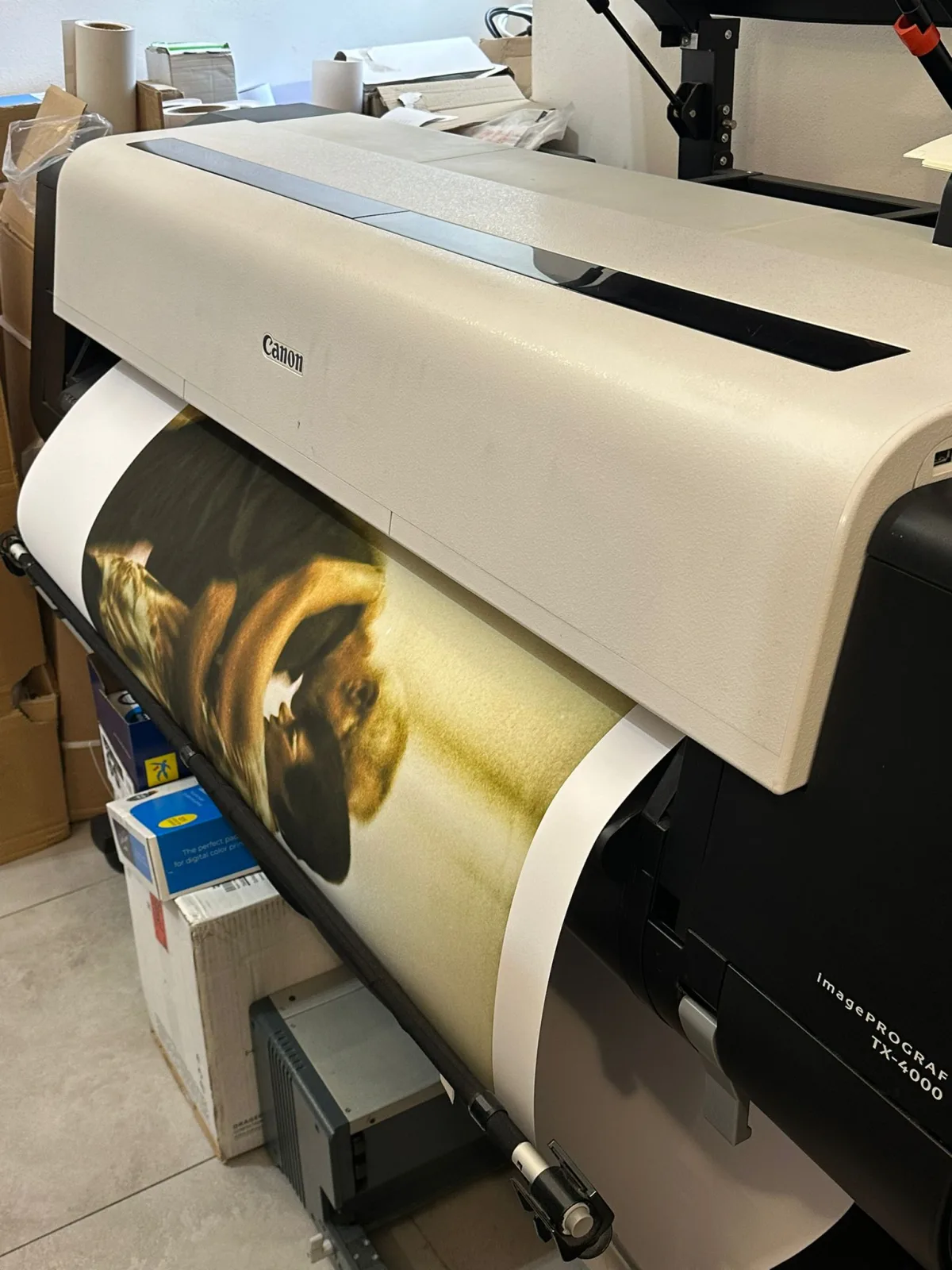
Three papers, three recipients
80-90 gsm CAD paper
The working drawing- For: site use, internal checks, working copies, in-progress verification
- Result: crisp linework, neutral white, minimum cost
- Limits: creases easily, does not cope with damp, colour is accurate but not vivid
The right paper for drawings that will be annotated in pencil, folded and refolded, then binned at the end of the job.
120 gsm paper
The drawing you hand over- For: clients, authorities, planning applications, reports to be filed
- Result: more body, survives folding without splitting along the crease, fuller colour on hatching
- Cost: € 8-10 per metre
When a drawing ends up in a file that someone will open and close repeatedly, 120 gsm pays for itself: 90 gsm, folded and reopened ten times, tears along the crease.
Photo or coated paper
Renders and presentations- For: renders, competition boards, client presentations, exhibitions
- Result: deep blacks, smooth gradients, saturated colour — what a render needs in order not to look flat
- Careful: you cannot annotate it and you cannot fold it
If the drawing contains a photorealistic image, CAD paper penalises it considerably: the render loses contrast and looks washed out.
The PDF: scale is the first thing you lose
The number one problem with drawings is not printing: it is that the file arrives without a verifiable scale, and nobody notices until somebody measures on paper.
The rules that avoid it:
- Export a PDF at sheet size, not "fit to page". If the drawing is A0, the PDF must be 841 × 1189 mm. A PDF exported at A4 and then enlarged on the plotter carries a false scale.
- Always include a graphic scale bar, not just the wording "1:100". The wording lies the moment someone prints reduced; a graphic bar scales with the drawing and stays true.
- Apply pen weights before exporting. Files exported without a pen table come out with every line the same: the drawing becomes unreadable because the hierarchy between walls, furniture and dimensions disappears.
- Check your hatching. Very dense fills print as a uniform grey smudge. If two materials are distinguished only by hatch density, check a small printed proof before running six A0 sheets.
- Fonts and text: embed the typefaces or convert to outlines, as with any PDF.
If a drawing arrives as DWG we can print it, but PDF remains the safe route: fewer variables between what you see and what comes off the machine.
Folding: how a set of drawings is handed in
An A0 drawing is not handed to an archivist rolled up: it is folded to A4, the size of a file, with the title block showing on the outer face. Whoever opens the folder must be able to read which drawing it is without unfolding it.
The folds we do most often:
- Concertina — the most common for project drawings: it opens like a fan and closes without turning the sheet.
- Booklet — for drawings that stay in a bound set, with the binding edge left free.
- Archive format — a final fold to A4 with the title block outside, the one technical offices ask for when filing.
Two things to know beforehand:
- The fold has to be planned in the drawing. The title block must land in the right panel, and if the sheet was not set up with folding in mind it ends up halfway across a face. Tell us before printing: if needed, we move the title block.
- 90 gsm paper folded repeatedly splits along the crease. For drawings that will be handled often, go for 120 gsm.
Frequently asked questions
How is plotter printing priced?
By linear metre of roll, not per sheet: from € 5 per metre or part thereof, € 6 per metre on 90 gsm CAD paper, € 8-10 on 120 gsm. Two consequences: a short drawing costs the same as a tall one occupying the same metre, and bringing several drawings together costs less than separate passes.
How do I export a PDF from AutoCAD without losing scale?
Export at true sheet size (an A0 must produce an 841 × 1189 mm PDF), not with "fit to page", and apply the pen weight table before exporting. Always include a graphic scale bar: the wording "1:100" becomes false the moment someone prints reduced, the bar does not.
Which paper should I choose for drawings?
90 gsm for working copies and site use; 120 gsm for anything handed over or filed, because it survives folding without splitting; photo or coated paper if the drawing contains a render, which on CAD paper loses contrast and looks washed out.
Do you fold the drawings too?
Yes: concertina, booklet and archive format — the fold to A4 with the title block showing that technical offices ask for. Tell us before printing, because the fold has to be planned in the drawing: if the title block is not in the right panel it ends up halfway across a face.
Can I bring a DWG file instead of a PDF?
Yes, we can print it. But PDF remains the safe route: between a DWG opened on our machine and what you see there are more variables — fonts, pen tables, external references. If you are in a hurry and the drawing has to come out right first time, send the PDF.
◆ Keep reading
◆ Ready to print?