◆ In short
Three papers, three uses: 90 gsm (A2 € 6, A1 € 11, A0 € 15) for temporary display and conference posters; photo paper when there are images and rendering matters; 200 gsm fine art (A1 € 19, A0 € 27) for anything that will hang for years. Under spotlights choose matt: gloss glares and from half a metre you cannot read it. There are four decent ways to hang one without holes, and tape on the wall is not among them. If it has to travel, ask for a rigid tube: a folded poster has a crease forever.
The three papers, and when they actually matter
The difference between papers is not "nicer" or "less nice": it is how long the poster must last and what is printed on it.
90 gsm — A2 € 6, A1 € 11, A0 € 15. Standard plotter paper: crisp linework, perfect text, minimum cost. Ideal for conference posters, notices, week-long displays. On photographs and dark backgrounds its limit shows: black is never truly deep and gradients are less smooth.
Photo paper. When the poster is an image — an exhibition, a photographic bill, a reproduction — everything changes: solid blacks, saturated colour, continuous gradients. Choose it when the image is the content, not the frame around it.
200 gsm fine art — A1 € 19, A0 € 27. Heavy, textured paper printed with pigment inks. This is the paper for posters that hang for years without yellowing, and for art reproductions. You feel it in the hand, and it is the right choice when the poster is itself the object rather than the information.
Matt or gloss: matt nearly always. Gloss lifts colour but glares, and a glossy poster under a spotlight or near a window becomes unreadable from half a metre. Gloss makes sense in controlled light, not in a conference room full of fluorescents.
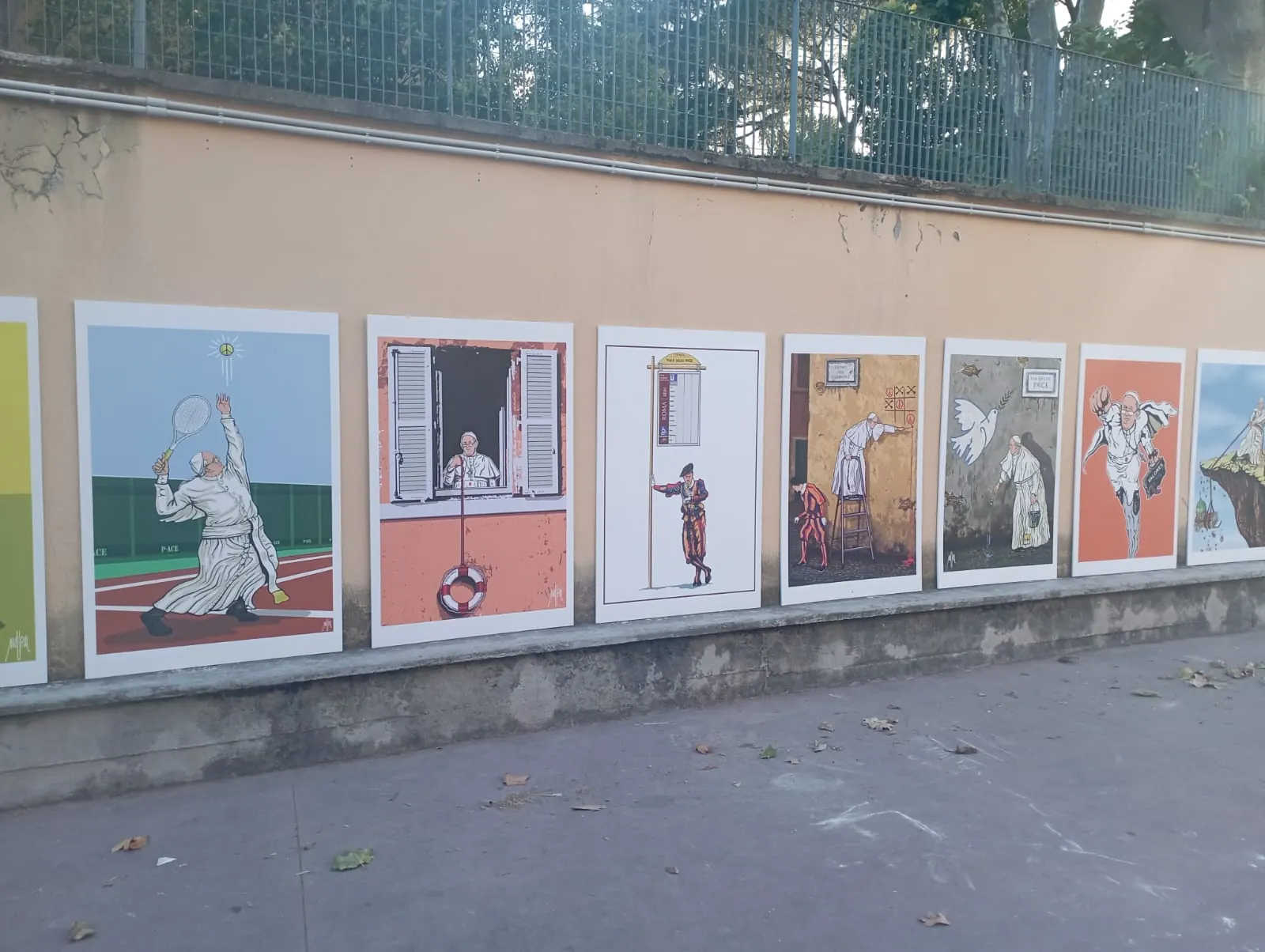
Four ways to hang it, and one to avoid
Removable adhesive strips
For painted wallsThe peel-away kind made for light frames: they hold a poster without drilling and come off without taking the paint, provided you pull them downwards as the instructions say.
Careful: on freshly painted walls, or on wallpaper, they can still lift the surface. Test in a hidden corner first.
Magnetic poster hangers
The way that ruins nothingTwo strips (wood or metal) clamping the top and bottom edge magnetically, with a cord going to a single nail.
- Pros: no holes in the poster, swap it in ten seconds, hangs well
- Cons: they cost more than the poster
The solution for anyone changing posters often — a shop window rotating promotions, a studio alternating prints.
Mounted on Forex
When it has to stand upThe poster is mounted on a rigid foamed-PVC panel: it becomes a self-supporting object, sits on an easel, hangs from two points and does not ripple with humidity.
The choice for trade fairs, waiting rooms and displays lasting months. For large posters it is the only method that avoids the "waves" of paper stuck to a wall.
A frame, if it stays for years
Genuine protectionUnder glass or acrylic a poster stays dust-free, does not yellow from contact and does not curl. If you printed on fine art to make it last, framing is the logical consequence.
Tip: with glass, matt paper is essential. A glossy print behind glass produces two overlapping reflections and becomes unreadable.
Tape at the corners
The way that ruins everythingThe most used and the worst: tape pulls the paper at four points, the poster ripples in the middle, and when you peel it off it takes either the print's surface layer or a piece of wall. And with humidity the corners curl anyway.
If there is truly no alternative, use paper washi tape along the whole top edge, which comes away without tearing.
Carrying it without ruining it
A folded poster has a crease forever. It does not iron out, does not flatten under books, does not fade with time: the paper fibre breaks along the fold and light makes it visible from any angle.
So if the poster has to travel — a conference, a trade fair, a delivery to another city — it should be rolled in a rigid tube, printed side inwards: that way the outside of the roll, the part rubbing against the tube, is the back.
Three habits:
- Roll it loosely. A tight roll leaves a curl the poster keeps for days. If the tube allows, choose a generous diameter.
- Do not roll anything else inside it. A rough sheet against the print marks it, especially on fine art.
- Unroll it on arrival and leave it flat under something light and even for an hour before hanging. It relaxes on its own.
For conference posters there is one more convenience: arriving with a tube means you still need a way to fix it to the board, and display panels often offer only velcro or pins. Ask in advance what the support is — it is the difference between hanging your poster in two minutes and hunting for tape at eight in the morning.
Frequently asked questions
Which paper should I choose for a poster?
90 gsm for temporary displays, notices and conference posters (A2 € 6, A1 € 11, A0 € 15). Photo paper when the poster is an image and rendering matters. 200 gsm fine art (A1 € 19, A0 € 27) for anything that will hang for years without yellowing.
Matt or gloss poster?
Matt nearly always. Gloss lifts colour but glares: under a spotlight or near a window the poster becomes unreadable from half a metre. And if you frame it under glass, matt is essential — gloss behind glass produces two overlapping reflections.
How do I hang a poster without ruining it?
There are four good routes: removable adhesive strips on painted walls, magnetic hangers if you swap it often, mounting on a Forex panel if it must stand up or last months, a frame if it stays for years. Avoid tape at the corners: it pulls the paper, makes the poster ripple, and peeling it off takes either the print or the wall.
How do I carry a poster without creasing it?
Rolled in a rigid tube, printed side inwards. A folded poster has a crease forever: the fibre breaks and never irons out. Roll it loosely, do not put other sheets inside the roll, and on arrival unroll it and leave it flat for an hour before hanging.
How much does an A0 poster cost?
On 90 gsm an A0 starts at € 15 (A1 € 11, A2 € 6). On 200 gsm fine art an A0 is € 27 and an A1 € 19. They are ready the same day, and larger runs bring the price down.
◆ Keep reading
◆ Ready to print?