◆ In short
Format follows the table, not the content: an A3 does not fit a bar table, and a menu that gets in the way ends up on the floor. Lamination turns a menu into a washable object — nearly always the sensible choice in a dining room: stain-resistant soft-touch for a refined venue, matt where there are spotlights, gloss only under controlled light. Allergens must be shown: it is a legal requirement, and on a menu it is solved with symbols beside each dish plus a key. The tip that saves the most: design it so prices can change without reprinting everything. From 50 to 1,000 copies, ready the same day.
The table decides the format
A menu is the one printed thing a customer holds while sitting at a laid table, and that space is tighter than it looks on a screen.
- Portrait A4 — the standard: it sits next to a plate, reads without spreading your arms, fits a menu holder. It carries twenty to thirty dishes comfortably.
- A4 in two columns or folded — when there are many courses or the menu is bilingual: a second column avoids printing two separate menus.
- A3 folded in half — it gives space and makes an impression, but on a table for two it takes half the surface. It suits restaurants with large tables, not a trattoria or a bar.
- Hardcover — the menu that stays with the venue for years, with replaceable inner pages. A different kind of investment: it costs more and signals a level.
A test that takes a minute and almost nobody does: print a full-size draft and put it on a table in your own venue, with a plate and a glass on it. Half of all format decisions change after that test.
And a note on the wine list: keeping it separate from the food menu is nearly always better. It updates on a different schedule, a different person at the table reads it, and a single over-thick menu never gets opened to the end.
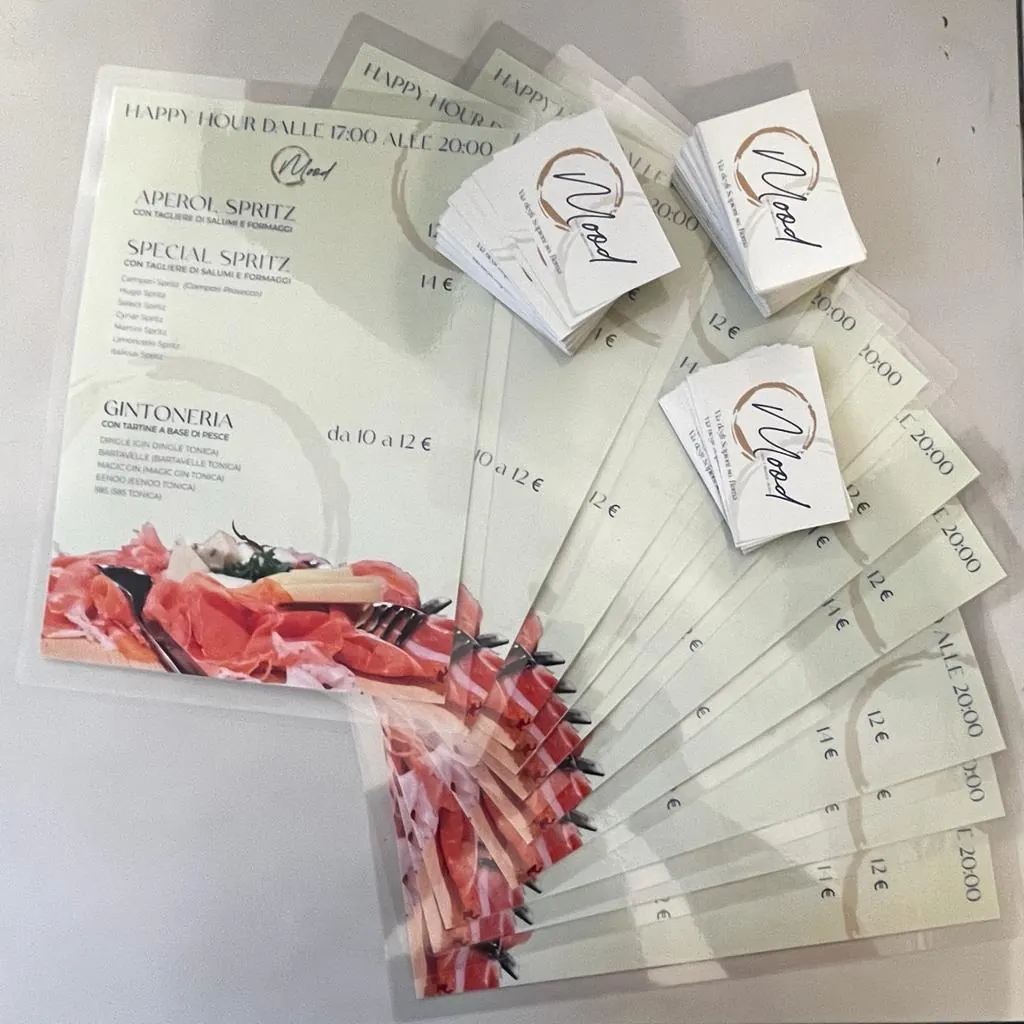
Lamination: which finish and why
Stain-resistant soft-touch
The choice of refined venuesVelvety to the touch, matt to the eye, and the film repels grease and wine marks.
- Pros: wipes clean with a damp cloth, no glare, and the hand immediately registers something well made
- Cons: costs more than the others
The right choice when the menu passes through hundreds of hands a week and the venue wants that care to show.
Matt
If the dining room has spotlightsNo glare: readable under any light, even with spotlights over the tables or a window behind you.
- Pros: always legible, modest cost
- Cons: colours are slightly softer than gloss
The safest choice if you do not know how the room will be lit six months from now.
Gloss
Only under controlled lightFull colour and photographs that pop: if the menu carries pictures of the dishes, gloss shows them best.
⚠️ But it glares, and under a spotlight the customer has to tilt the menu to read. Fine in venues with soft, diffuse light, not in a room with directional lighting.
It also holds fingerprints, which show on a menu handled constantly.
No lamination
Only if the menu is disposableIt makes sense in one case only: the daily menu, printed in the morning on plain paper and binned at night. There, lamination is unnecessary and wasteful.
In every other case an unlaminated menu lasts a week: it absorbs grease from fingers, stains at the first glass and curls at the edges.
Allergens: how to show them on a menu
Declaring allergens is a legal obligation for anyone serving food, and it covers fourteen substances identified by the European regulation (EU 1169/2011): among them cereals containing gluten, crustaceans, eggs, fish, peanuts, soybeans, milk, nuts, celery, mustard, sesame, sulphur dioxide and sulphites, lupin and molluscs.
On a printed menu the solution that works best is the simplest: a symbol or code beside each dish, plus a clearly visible key — not at the foot in 5 pt, but where someone looking will find it. Alternatively a line referring to a consultable document, which must genuinely exist and be up to date: that line alone, without the document behind it, is not enough.
⚠️ What each dish contains is known by the venue, not the printer. We print what you give us: the per-dish allergen list must be prepared — and kept current when a recipe or a supplier changes — by whoever cooks. If you are unsure how to word it, check with your adviser before printing the run.
Two practical points:
- Repeat the key on every page carrying dishes, not just the first. Someone opening the menu halfway will not go back to look for it.
- Symbols must stay legible after reduction: if they are clear in the file but print as dots, the information is there but not accessible — and you may as well not have included it.
Designing it so prices can change
This is the tip that saves more than any other, and it must come before layout, because afterwards it cannot be recovered.
Prices change — by season, by ingredient cost, because a dish leaves the menu. If the price is set inside the artwork, every adjustment means a full reprint. If the menu is designed to change, you change one page.
Three ways, from simplest to most structured:
- A separate price page. Dishes and descriptions on one side, the priced list on another: only the second gets reprinted.
- A hardcover menu with replaceable inner pages. The cover stays with the venue for years, the inner pages change as needed. The most elegant solution for anyone changing the menu every season.
- The daily insert. An A5 sheet printed in the morning — catch of the day, specials, the chef's suggestions — slipped into the fixed menu. It costs very little and takes pressure off the main menu.
On quantities: we print from 50 to 1,000 copies. For a venue the temptation is to order plenty because the unit cost falls; but if the menu changes in autumn, fifty extra copies in March are fifty copies to bin. Two considered runs beat one large mistaken one.
One last thing: if you need two languages, consider a single page in two columns rather than two separate menus. It costs less, updates once, and the foreign guest does not have to ask for the menu "in English" — one small friction removed at the start of the evening.
Frequently asked questions
Which format should I choose for a restaurant menu?
The table decides: portrait A4 is the standard and carries twenty to thirty dishes; A4 in two columns or folded suits many courses or bilingual menus; folded A3 only makes sense with large tables, since on a table for two it takes half the surface. Always test a full-size draft on a table in your own venue.
Is it worth laminating a menu?
Nearly always yes: without lamination a menu lasts a week, because it absorbs grease from fingers and stains at the first glass. Stain-resistant soft-touch for refined venues, matt where there are spotlights, gloss only in soft light. The one exception is the daily menu, printed in the morning and binned at night.
How should allergens be shown on a menu?
It is a legal obligation covering the fourteen substances in regulation EU 1169/2011. On a printed menu, a symbol beside each dish plus a clearly visible key, repeated on every page with dishes, works best. ⚠️ What each dish contains is known by the venue: the list must be prepared and kept updated by whoever cooks — we print what you give us.
How can I change prices without reprinting the whole menu?
By designing for it: a separate price page from the descriptions, a hardcover menu with replaceable inner pages, or a daily A5 insert for specials and fresh fish. If the price is set inside the artwork, every change means a full reprint.
Do you lay out the menu as well?
Yes, through our in-house design studio: layout from scratch, or a template you reuse at every menu change. We print 50 to 1,000 copies and menus are ready the same day. If your venue is around the Vatican, Borgo Pio, Castel Sant'Angelo or Prati, we deliver on foot.
◆ Keep reading
◆ Ready to print?