◆ In short
A5 (148 × 210 mm) is the right size nine times out of ten: readable from a distance, fits in a bag, costs little. A6 is for street handouts, A4 for when you genuinely have something to explain. The reference stock is 130 gsm coated; below that it feels like a photocopy, above 170 gsm you are really talking about a poster. For 1,000 A5 double-sided colour flyers prices start at € 50-70, and at 5,000 copies the unit cost nearly halves. With a print-ready file, up to a thousand copies we deliver within 2 hours.
Three sizes, three ways of ending up in someone's hand
A6 — 105 × 148 mm
The handout formatPostcard-sized: fits in a palm, slips into a pocket, cheap even in large runs.
- When: hand distribution, under windscreen wipers, on counters, inside envelopes
- How much text fits: one promise and a contact, no more
- Careful: in a street handout 90% ends up in a bin within ten metres. A small size reduces the waste, it does not remove it
A5 — 148 × 210 mm
The most requested, and nearly always rightHalf an A4: readable from a metre away, fits a bag without folding, carries a large photograph and a short list.
- When: openings, promotions, takeaway menus, events, courses
- Why it works: the cheapest size that is still readable pinned to a noticeboard
- Our standard: 130 gsm coated, double-sided
A4 — 210 × 297 mm
When there is genuinely something to explainThe full sheet: it holds a price list, a programme with times, a spec sheet.
- When: price lists, course programmes, service overviews, full menus
- Cons: bulky, folds itself in a bag, costs twice an A5
- Alternative: if the content overflows, instead of a cramped A4 go for a three-panel leaflet — same sheet, six orderly panels
The paper: 130 gsm, and when to change it
A standard flyer prints on 130 gsm coated. That is the point where paper stops feeling like a photocopy and starts feeling deliberately printed: it has body, it does not show through when double-sided, it does not crumple in a pocket.
- 90-100 gsm — only for very large runs where cost rules. The flyer feels limp and signals little value.
- 130 gsm — the balance: cost, colour rendering, substance. What we recommend unless there is a reason to do otherwise.
- 170 gsm — when the flyer has to last: it stays on the fridge, gets pinned to a noticeboard, goes into a folder with other material.
- 200 gsm and above — that is no longer a flyer, it is a poster or a promotional card. It also changes how it is treated: kept, rather than read and binned.
On gloss or matt: gloss makes photographs pop and is the choice of restaurants, gyms and events. Matt reads better under artificial light and does not glare — better when there is a lot of text, or when someone might want to jot a note on it.
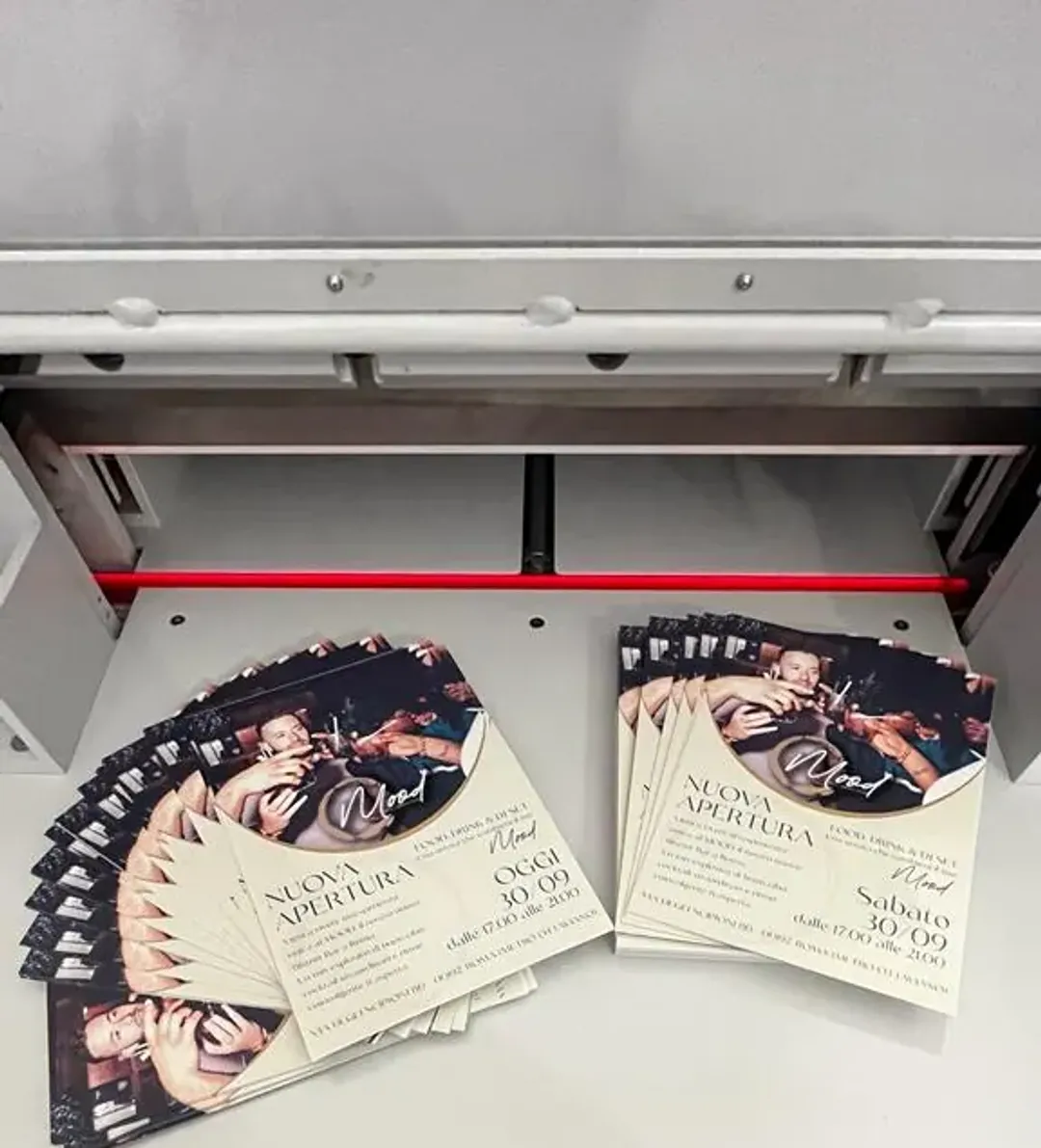
How many copies you actually need
This is where most budget gets wasted, in both directions.
The unit cost drops considerably with quantity: 1,000 A5 double-sided colour flyers start at € 50-70, and at 5,000 copies the unit cost nearly halves. Seeing that number, the temptation is to order plenty because "it barely costs more".
But results do not scale with copies: they scale with where the copies end up. A thousand flyers handed out in front of a university on the right day are worth more than five thousand tucked under windscreen wipers in a car park. And leftover flyers do not keep: if there is a date on them, by January they are recycling.
A practical rule from the counter: order for the distribution you have already planned, not the one you might do. If the first run works, the second reprints the same day — and costs little more precisely because the file is ready and set up.
⚠️ If there is a date on the flyer, size the run for that event and nothing else. It is the most frequent and most expensive mistake: five thousand copies reading "Saturday 12 October" are worth nothing on 13 October.
What to put in, and what to take out
A flyer gets two seconds of attention before someone decides whether to keep it. In two seconds a person reads one line, recognises an image and looks for a reason not to bin it.
The four things that must be there:
- One single thing to understand. Not three offers: one. The other two weaken the first.
- A reason to act now — a date, a deadline, limited places. Without urgency the flyer becomes "I'll look at it later", and later does not exist.
- How to reach you: address, phone, opening hours. It sounds obvious, and it is missing from one in three flyers that reach us for correction.
- A QR code, if you need one. But make it at least 2 centimetres square and try scanning it off printed paper before ordering a thousand copies: below 2 cm, or printed on a dark background, many phones will not read it.
What can nearly always go: the company history, the full list of services, the justified paragraph filling the bottom of the page. White space is not wasted space: it is what makes the rest noticeable.
The file, in three lines
The same rules as business cards apply, and there is a dedicated guide: 3 mm of bleed on every side, at least 4 mm of safety margin for text and logo, CMYK at 300 dpi, a PDF with embedded fonts.
Two things specific to flyers:
- Double-sided must flip on the long edge. On a portrait A5 that means the back reads by turning the sheet like a page, not by flipping it over. If in doubt, send a two-page PDF in the right order and we will handle it.
- Dark solid backgrounds are less forgiving on large runs: a crease, a fingernail mark or a scratch shows immediately. If the flyer will be handled a lot, either go lighter or budget for lamination.
If the file is not ready we can prepare it: that is design work, quoted separately, and we show you a proof before running the full print.
Frequently asked questions
A5 or A6 flyers?
A5 if the flyer has to be read — pinned to a noticeboard, left on a counter, put in a bag. A6 if it is handed out in the street, where cost per copy rules and attention lasts two seconds. If in doubt, A5: the most requested and most versatile size.
How much do 1,000 A5 colour flyers cost?
For 1,000 A5 double-sided colour flyers on 130 gsm coated stock prices start at around € 50-70. The unit cost drops considerably with quantity: at 5,000 copies it nearly halves. We print from 100 to 10,000 copies.
What paper weight is used for flyers?
130 gsm coated is the standard: it has body, does not show through when double-sided and renders colours well. Go up to 170 gsm when the flyer has to last — pinned up or kept in a folder. Below 130 gsm it looks like a photocopy.
Can you print them the same day?
Yes. With a print-ready file and a reasonable order — up to about 1,000 A5 double-sided colour copies — we deliver within 2 hours. Larger runs take 4-6 hours. For a genuine emergency, call 06 4424 0707 first so we can queue the job straight away.
How big should a QR code be on a flyer?
At least 2 centimetres square, with good contrast — dark on light always works, light on dark does not always. Before running the full print, print a proof and scan it off the paper, not off a screen: that is the test that prevents a thousand copies with an unreadable code.
◆ Keep reading
◆ Ready to print?