◆ In short
There are four ways to bind a thesis in Italy: thermal (soft cover, the fastest), hardcover (the official copy, book-like), spiral (pages lie flat, ideal for drafts) and perfect binding (square glued spine, typical of publishing). The short answer: hardcover for the official copy and the archive, thermal for working copies and gifts, spiral for drafts to review with your supervisor. Always check your degree programme's rules: almost every university asks for at least 1 hardcover copy plus the PDF/A. If you are in Rome, current times and prices are on the thesis binding in Rome page.
Which binding to choose and when
The short answer: hardcover for the official copy and the archive, thermal for working copies and the ones you give away, spiral for drafts you still have to correct. The table below maps every type of copy you will actually need.
Official copy for the committee
HardcoverProfessional look, lasts decades, always accepted.
Copy for the university library
HardcoverAlmost every university requires it as mandatory for the archive.
Working copy for the supervisor
ThermalCheaper, ready in 5 minutes, holds up well in use.
Copy for friends and family
ThermalCosts less, fine as a keepsake, light to ship.
Personal archive copy
HardcoverStays beautiful on your shelf at home for a lifetime.
Copy as a gift (graduation)
HardcoverIt's the "book" of your university career: it deserves the hardcover.
Draft to review with your supervisor
SpiralIt opens flat and stays open on the desk: you can annotate it by hand, chapter by chapter, without the volume snapping shut.
Handouts and study notes
SpiralSame principle as the draft: cheap, easy to photocopy and comfortable to consult. It is not a copy you hand in.
The 4 binding types compared
Thermal: the pages are joined by heat-activated glue inside a personalised soft cover. It is the fastest technique and the one you see done at the counter in minutes.
Hardcover: the page block is glued into a covered board case, with foil printing on the front and the spine. It is the "official" binding, the only one no committee ever objects to.
Spiral: a plastic or metal coil runs through a row of punched holes. It is not a submission binding, but it is unbeatable at one thing: the pages open flat and stay there.
Perfect binding: the spine is milled and glued square, like books in a bookshop. It is a print-house process, uncommon in copy shops and rarely requested for a thesis.
ⓘ For foil colours and hardcover materials see the thesis binding in Rome page, which also carries current times and prices.
Thermal binding
- ✓Ready in 5 minutes at a copy shop: perfect when you are short on time
- ✓The cheapest among the bindings acceptable for a thesis copy
- ✓Cover customisable with your university's colours, font and logo
- ✓Light, easy to ship and to carry
- ✓Accepted by most universities for the working copy
- –Soft cover: it creases with heavy use over time
- –Less "book-like": fine for the working copy, less so for the official one
- –Not always accepted as an archive copy by university libraries
Best for
Working copies for your supervisor and copies to give to friends and family.
Hardcover (rigid thesis)
- ✓Covered board case: identical to a published book
- ✓Foil printing on front and spine in 7 colours of your choice
- ✓Lasts decades: it stays perfect on the shelf for a lifetime
- ✓Accepted everywhere, by any committee and university library
- ✓At GUUG: ready in 2 guaranteed hours, or shipped across Italy in 24-48h
- –Costs more than thermal because of materials and foil work
- –Longer lead time: 2 hours in store or 24-48h with shipping
- –Heavier to carry if you need several copies
Best for
Official copy for the committee, library archive copy and keepsake copy.
Spiral binding
- ✓Pages open flat and stay open on the desk
- ✓Very comfortable to annotate and to photocopy
- ✓The cheapest of the four techniques
- ✓Ready in minutes, like thermal binding
- –No committee accepts it as an official graduation copy
- –You cannot print title and author on a coil spine
- –On very thick volumes the coil opens up and deforms
Best for
Drafts to review with your supervisor, handouts and notes. Never the copy you hand in.
Perfect binding
- ✓Square glued spine: the look of books in a bookshop
- ✓Title and author can be printed on the spine
- ✓Lighter than a hardcover for the same page count
- –Soft cover: it bends and wears at the corners
- –The milled spine can crack if the volume is forced open
- –It is a print-house process: few copy shops offer it and lead times get longer
Best for
Editorial volumes and catalogues. We do not offer it at GUUG: for a thesis with a "book" look, the way to go is the hardcover.
What Italian universities require
Binding rules vary from university to university, and in some cases even from department to department. We give you the most common guidelines we see in Rome, but the first step is always to check the regulations of your specific degree programme with the registrar office.
The most common case, the one we see almost daily at the counter: 1 hardcover copy for the library + 1 PDF/A uploaded to the submission portal. Copies for the supervisor and co-supervisor are optional or required only if the professors want physical ones.
The intermediate case, frequent for master's degrees and doctorates: 2-3 hardcover copies (1 library + 1-2 committee) + PDF/A. Doctoral theses often have stricter requirements (4-6 hardcover copies).
The most digital case, still a minority but growing: only a PDF/A uploaded to the portal, zero paper copies required. Many universities are moving in this direction to reduce paper. But even under this rule, many students still bind at least 1 hardcover copy as a personal keepsake and to show their family.
On spiral and perfect binding the rules are clear: no university accepts spiral as an official graduation copy, while perfect binding is usually tolerated where the regulations generically ask for a "bound copy" without naming the technique. When in doubt, a hardcover is never questioned by any committee.
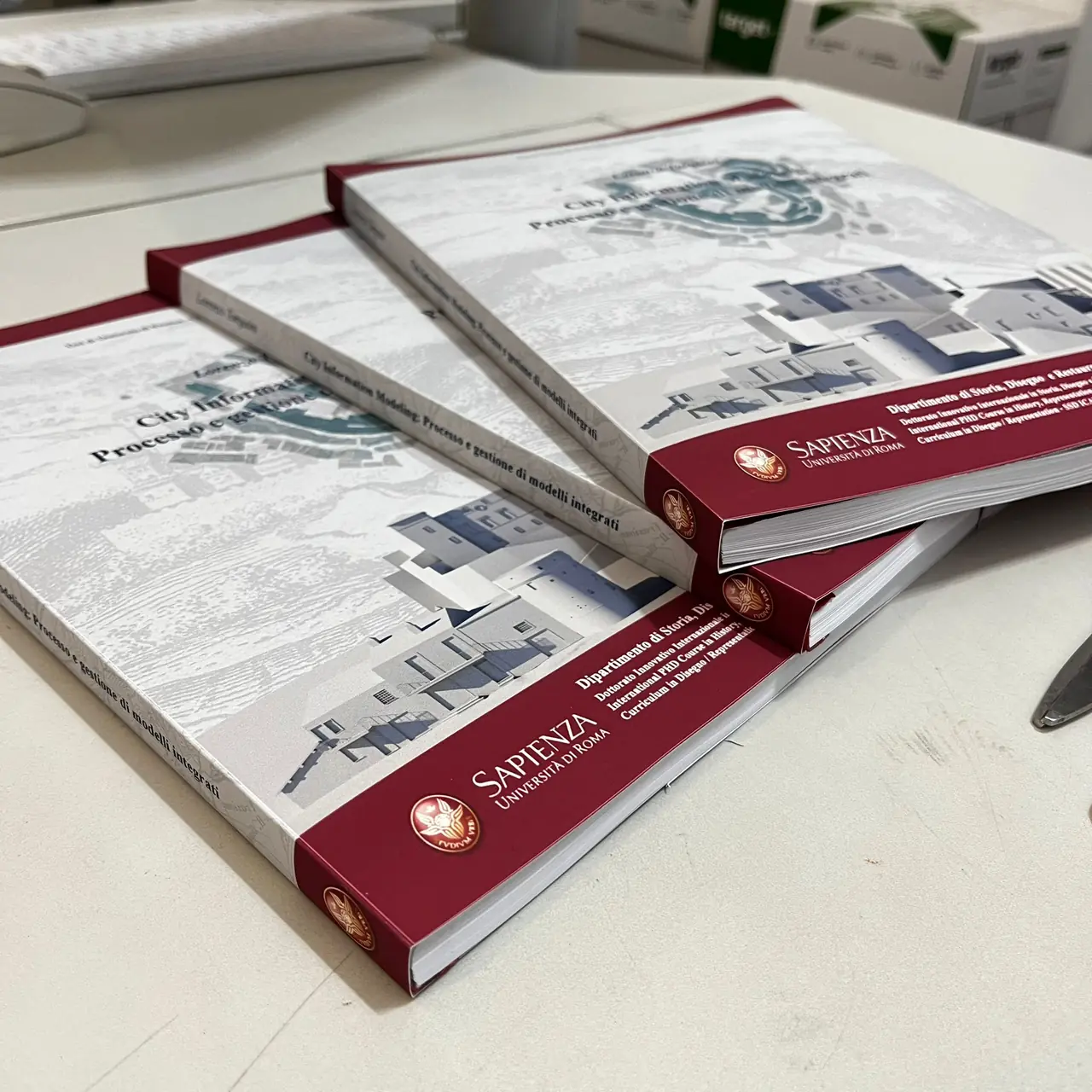
Rome specifics: Sapienza generally requires 1 hardcover copy (bordeaux is the usual colour) + PDF/A. LUISS prefers midnight blue. LUMSA uses dark green. Roma Tre goes with navy blue. For university-by-university details, go to your university's page.
Rome, colour by colour. The cover colour is set by the faculty, not the regulations: the two we are asked about most are Engineering and Law, which each have a dedicated university-by-university guide.
6 common mistakes to avoid
As a copy shop binding over 1,000 theses a year, we regularly see a few mistakes that could be avoided with a little planning. A quick checklist before you order.
Leaving the binding until the last day
Thermal takes 5 minutes, but the hardcover needs at least 2 hours. If your defence is tomorrow morning and at 6pm you realise you haven't bound it yet, you're in a scramble. Plan the binding AT LEAST 1 day before submission: you gift yourself peace of mind and time to check the final result before the day of the defence.
Not checking how many copies you need
Every university has different rules: some want 5 hardcover copies, others 1 hardcover + 3 thermal, others still only the digital PDF/A. Call your programme's registrar office and ask EXACTLY how many copies are needed and of what type. Ordering too many copies is costly, ordering too few is a last-minute disaster.
Not checking the spelling on the title page
A wrong capital "L" in the supervisor's surname, a badly abbreviated university, a wrong academic year: once it's bound as a hardcover, changing it means redoing everything from scratch. Before handing over the PDF for binding, have 2 different people proofread the title page.
Underestimating the weight of the hardcover thesis
A 200-page hardcover thesis weighs about 800g-1kg. If you need 5 copies for the committee, that's 5 kg to carry. It's not a disaster, but if you're heading into central Rome by scooter or public transport, organise the transport in advance. For DHL shipping, the weight is included in the standard cost.
Choosing cover + foil without testing them together
White foil on a white cover = invisible. Gold foil on a straw-yellow cover = barely visible. When you choose the two colours, always weigh up the contrast: some winning combinations — bordeaux + gold (classic), midnight blue + silver (LUISS-style), dark green + gold (LUMSA), black + gold or black + silver (understated and elegant).
Thinking thermal is "a cheaper, worse binding"
Thermal binding is not a shortcut: it's a different technique with its own strengths. For working copies or copies to give away it's the most sensible choice. You save money on those and invest in the official hardcover archive copy. It's a rational allocation of your thesis budget, not a compromise.
Frequently asked questions
Which binding is mandatory for the graduation committee?
At most Italian universities the regulations require at least ONE hardcover copy for the committee + library archive. Additional copies for the supervisor, co-supervisor or friends can be thermal. Always check your degree programme's official regulations with the registrar office: rules vary even between departments of the same university.
Does thermal binding hold up over time or does it deteriorate?
Professionally done thermal binding lasts for years without problems. If you keep it on the shelf and don't open it constantly, it can last 10-15 years in perfect condition. The soft cover creases a bit if you handle it often (bent edges, folds in the corners), but the internal block stays solid. For the "forever" archive copy, the hardcover is better.
How many types of foil are there for the hardcover?
At GUUG we offer 7 foil colours: gold and silver (the classics, chosen by most students), bronze (warm, perfect for humanities and architecture), black (understated, great on white covers), white (minimal, perfect on dark covers), fuchsia (creative, fashion and communication schools), light blue (soft, paediatrics and education sciences). Choose the one that best matches the cover colour and your faculty's identity.
How many binding types are there for a thesis?
Four in practice: thermal (heat-glued soft cover), hardcover (covered board with foil printing, the official copy), spiral (coil through punched holes, for drafts) and perfect binding (square glued spine, a print-house process). For the copy you hand in, the real choice is between the first two. Current times and prices are on the thesis binding in Rome page.
Which cover colour goes best with gold or silver foil?
Classic combinations that always work: bordeaux + gold foil (Italian academic tradition, Sapienza), midnight blue + silver or gold foil (LUISS, modern universities), dark green + gold foil (LUMSA), black + gold foil (understated and elegant), white + silver or black foil (contemporary, design schools). For your specific faculty, see our guide to thesis colours.
Can I do the thermal first and the hardcover later if I change my mind?
Yes, though it's not advisable. Once it's thermally bound, the thesis is "closed": to make the hardcover you have to print the internal block again and bind it. A waste of time and paper. Decide the binding type FIRST and order accordingly. If you're unsure: always order 1 hardcover + 2-3 thermal, and you cover every situation.
Can the hardcover be customised beyond the colour?
Yes. You can choose: the cover colour (a wide range across bordeaux, blue, green, black, etc.), the front text (title, author, university, year), the spine text (abbreviated title + year, readable when the book is closed on a shelf), the foil colour (gold, silver, bronze, fuchsia, black, white, light blue). On shop.guug.it you choose everything at order time with a visual preview of the result.
How many hardcover and how many thermal copies should I order?
The most common scheme for an Italian thesis: 1 hardcover for the university library/archive + 1-2 hardcovers for the supervisor and co-supervisor (check whether they want them or whether the PDF is enough) + 2-4 thermal for friends and family who want a keepsake. Total: 2-3 hardcover + 2-4 thermal. If your family or partner wants a particularly beautiful copy, order them a hardcover too.
Is spiral binding suitable for a graduation thesis?
For the copy you bring to the committee, no: no Italian university accepts it as an official copy, and you cannot print title and author on a coil spine. For the draft you review with your supervisor, though, it is the best of the four: it opens flat, stays open on the desk and takes handwritten notes without fighting you. Many students use spiral for revisions and then a hardcover for submission.
Is perfect binding suitable for a thesis?
Technically yes (the result resembles a bookshop book), but it is uncommon in copy shops because it is a print-house process with longer lead times. The cover stays soft, so it wears at the corners, and the milled spine can crack if the volume is forced open. We do not offer it at GUUG: for a thesis with a book-like look we recommend the hardcover, which lasts decades and is accepted everywhere.
Which is the best binding for a thesis?
There is no single best binding: it depends on what that copy has to do. For the official copy and the library archive the answer is the hardcover, the only one no committee objects to and the one that lasts decades. For working copies and gifts, thermal does the same job at a much lower cost. For drafts to correct, spiral. The most frequent combination we see at the counter is 1 hardcover plus 2-4 thermal copies.
◆ Keep reading
◆ Ready to print?